
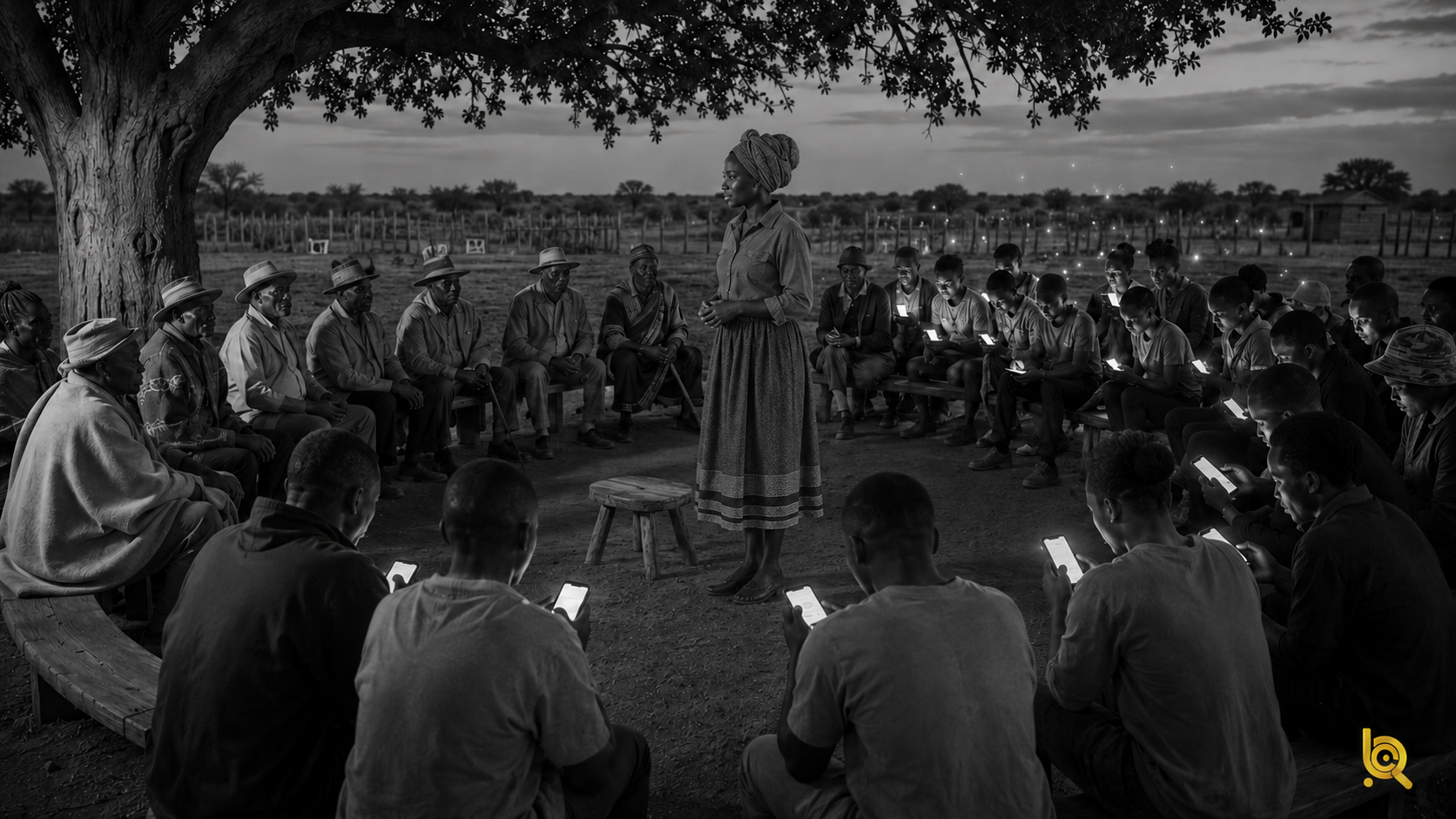
The kgotla is one of the oldest democratic institutions on the African continent, and one of its most enduring. For centuries, it has functioned as the village assembly at which community members could speak, dispute, petition, and hold those in authority to account. The kgosi presided, but consensus was the objective. The principle embedded in it — that governance requires public deliberation, not just public announcement — predates both the Westminster parliament and the concept of representative democracy as the West defines it. When political scientists explain why Botswana has maintained democratic stability since independence while many of its regional neighbours did not, the kgotla system is consistently cited as one of the structural reasons.
And yet something has changed. Or perhaps more precisely, two things are changing at different speeds, and the gap between them is where democratic participation in Botswana is now working itself out.
The Kgotla’s Documented Tensions
Research on the kgotla is not uniformly celebratory, even among scholars who respect the institution’s historical importance. A 2026 DemocracyNext paper on deliberative democracy in Africa notes that “like any form of democratic practice, these deliberative traditions are not perfectly inclusive and are open to capture by political elites.” Academic reviewers of recent peer-reviewed work on the kgotla have pointed out that the institution has historically been a site of patriarchy, gerontocracy, and Tswana-language and cultural dominance — with women, youth, and non-Tswana communities systematically marginalised in ways that formal inclusion policies have addressed only partially.
The Bertelsmann Transformation Index 2026 report on Botswana is more direct. It notes that beyond the Budget Pitso, “consultations in kgotla meetings tend to be superficial and focused on informing communities of decisions already taken.” This is the critical tension: the kgotla’s form — the gathering, the open forum, the chief presiding — has survived, but its function as a space where public views genuinely shape decisions before they are made has, in many instances, hollowed out. Batswana attend kgotla meetings. The question is whether attending constitutes participation in a meaningful sense, or whether it constitutes witnessing.
There have been exceptions that illuminate the rule. During the previous administration, reports emerged of police disrupting kgotla meetings in the Central District as Bangwato communities gathered to discuss tribal political matters — a development described in the BTI as running “counter to Botswana’s democratic tradition, which is rooted in the kgotla as a forum for consultation.” When a government uses law enforcement to prevent the kgotla from functioning as designed, it reveals both the institution’s remaining authority and its vulnerability to executive pressure.
The Parallel System
Young Batswana are not opting out of political participation. They are conducting it in a different arena, on a different timeline, with different tools.
The Afrobarometer data from its most recent survey rounds makes an observation that should be read alongside the kgotla debate: approximately 48 percent of Africans report attending community meetings, a figure higher than in Latin America and most other surveyed regions. Community participation is not absent from Botswana. But the form it takes for young urban Batswana increasingly runs through WhatsApp groups, X threads, Facebook pages, and TikTok commentary rather than through the village assembly.
This is not, on its own, a crisis. Digital platforms have enabled political mobilisation across the continent in ways that have strengthened democratic outcomes — the 2024 Botswana election, in which the ruling BDP was voted out after 58 years, saw an 80-percent turnout, driven in significant part by an electorate galvanised by social media discussion of economic failures and unfulfilled expectations. Young Batswana formed political opinions, shared information, checked facts, and organised social networks through digital platforms. The election’s outcome — accepted immediately and peacefully by all parties — validated a system in which that digital participation ultimately fed into formal democratic process.
The tension is not between digital and traditional participation, but between digital speed and institutional responsiveness. A community can form, share, and crystallise an opinion on a government decision within hours on social media. The kgotla process, and the formal democratic institutions that sit above it, operate on a timescale measured in months and years. When the gap between those timescales is large enough, the result is not engagement — it is disillusionment. Young Batswana increasingly see institutions as slow, opaque, and unresponsive to the clarity they can achieve on a screen in an afternoon.
The New Administration’s Response
The Boko government has, at least in its stated intentions, identified this gap. Government statements have spoken of “proactively engaging civil society and youth to integrate the traditional kgotla system alongside modern mechanisms for wider citizen engagement.” A public participation bill was under development as of late 2025, described as mandating citizen engagement at every stage of law and policy development, not merely as a consultation formality. Decentralisation is being reconceptualised, in government language, as a genuine transfer of fiscal and decision-making authority to local structures, not merely an administrative decentralisation of service delivery.
These are the right frameworks. But the gap between framework and implementation in Botswana’s governance history is one the public has learned to account for. The test of any public participation bill is not its text — it is whether a community in Maun or Serowe that objects to a government decision during the formation stage of that decision can demonstrably change its outcome. If the answer is no, the bill formalises consultation without formalising influence, which is the same problem the kgotla already has.
Two Democracies, One Country: Botswana’s Participation Problem
The kgotla does not need to be replaced. What it needs is to be honest about what it has become in many of its modern iterations — a venue for announcement, not a venue for decision-making — and to either regain the latter function or acknowledge that it now operates alongside a parallel system of citizen political expression that has its own logic, its own speed, and its own legitimacy. A democracy that is celebrated internationally for its institutions while its young citizens conduct their actual political lives outside those institutions is not failing — but it is asking itself a question it has not yet answered: whose participation, and in what form, is Botswana’s democracy actually designed to receive?
Sources: Bertelsmann Transformation Index 2026; Afrobarometer; DemocracyNext; The Conversation; Democracy in Africa; Daily News Botswana; University of Botswana research