
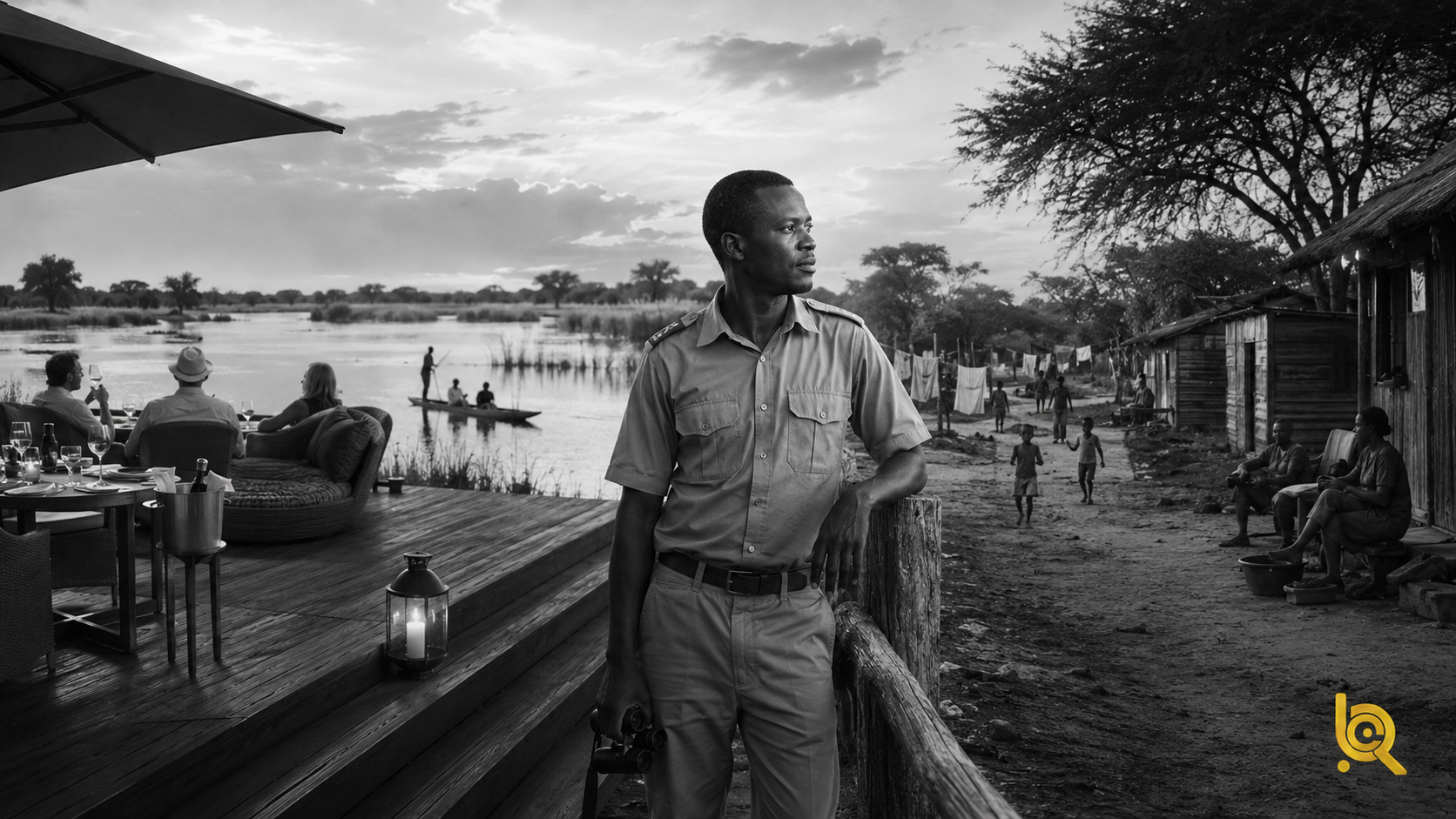
Botswana’s tourism strategy is, by almost any analytical standard, the most coherent low-volume, high-value model in Africa. The country made a deliberate choice, written into concession law and consistently enforced, to limit the number of visitors in its most ecologically sensitive areas, charge premium prices — $1,000 to $2,500 per person per night at the top-end lodges in the Okavango Delta, with the market floor at around $600 for mid-range options — and protect the wilderness assets that give those prices their justification. The Okavango Delta received approximately 100,000 visitors across its 60-odd camps and lodges annually, generating tourism revenue that Africa Geographic estimates contributes roughly 13 percent of Botswana’s GDP through the Okavango circuit, against a national tourism revenue figure of $393 million in 2023.
The model is celebrated internationally, cited in Rwanda’s tourism strategy documents, referenced in Zambia and Zimbabwe’s conservation planning, held up as proof that Africa does not have to choose between conservation and economic return. Minister Wynter Mmolotsi said it plainly at a May 2026 consultative meeting with community-based organisations in Maun: “We no longer have the luxury of relying on beef and diamonds. Tourism must save Botswana’s economy.”
Given that, the question of who actually benefits from the $2,500-a-night Okavango experience is not an abstract one. It is one of the central distribution questions in Botswana’s economic future, and the honest answer is more complicated than the model’s reputation suggests.
The Value Chain and Where It Leads
Most of the luxury lodge brands operating in the Okavango Delta are internationally owned and managed — Wilderness Safaris, &Beyond, andBeyond, Singita, Ker & Downey. These are not fly-by-night operators: they are conservation-committed, professionally run, and in many cases genuinely invested in their Botswana concessions at a level that community-owned operations could not replicate without significant capacity development. But they are also headquartered, in many cases, outside Botswana — with management, branding, marketing, and financial operations generating value that accrues in South Africa, the UK, or elsewhere, and guests who book through international travel agents adding another layer of value extraction before the money reaches a Botswana bank account.
The concession structure, managed through the Botswana Tourism Organisation and local land boards, requires operators to pay lease fees and resource royalties, and to demonstrate in their tender submissions that they have a limited environmental impact. This is the right framework. But the fee levels that Botswana captures through the concession process are, in some analyses, set at levels that are competitive for operators at Okavango prices — which means they may be set below what the market would in fact support, leaving value on the table that the state or communities could claim without affecting operator viability.
The model protects the ecosystem. The question is whether it distributes the value generated by that ecosystem in the proportion that the people who live around it deserve.
The CBNRM Promise and Its Reality
Botswana’s Community Based Natural Resources Management system — formalised from the early 1990s and updated through a new CBNRM Act signed in January 2026 — is the mechanism designed to ensure that local communities receive a meaningful share of tourism revenue rather than only entry-level employment and distance from wildlife. Under CBNRM, community trusts in areas like the Okavango and Chobe are allocated concessions or wildlife management areas, which they can develop through joint venture agreements with private operators.
The evidence from those joint ventures is mixed. Academic research from the Sankuyo Tshwaragano Management Trust in the Okavango Delta found that wage income from community members employed in lodge operations was more significant for household poverty alleviation than the dividend income flowing through the trust itself — meaning the CBNRM structure, at least in that case, was delivering benefit primarily through employment rather than through capital accumulation. Minister Mmolotsi’s Maun meeting acknowledged this directly: he noted that while community-based organisations have historically generated significant revenue, “mismanagement of funds has frequently led to internal conflicts and disputes,” and urged community trusts to adopt a professional business mindset. The CBNRM Act’s implementation is still being finalised, with regulations under review as of June 2026.
About 40 percent of employed adults in Ngamiland — the district that hosts the Okavango Delta — work in the tourism industry. That is a genuinely significant employment figure. But employment in a $2,500-a-night economy, predominantly in kitchen, housekeeping, guiding, and logistics roles, compensated at wages that reflect the domestic labour market rather than the international price of the experience, is a different thing from economic participation in that economy at the level the revenue would support.
What the Model Needs Next
The low-volume, high-value model is the right conservation strategy and it should be protected. The question is not whether to change the model but whether to renegotiate the distribution of value within it. Three levers are available.
First, concession fees and royalties can be structured to capture more of the premium that the conservation model itself creates. If the Okavango’s exclusivity and pristine condition is worth $2,500 a night to an international visitor, and that condition is maintained at national cost — through conservation management, anti-poaching, UNESCO World Heritage Site obligations — then the fee structure for accessing that asset should reflect its value, not a competitive discount designed to attract as many operators as possible.
Second, community trust governance and capacity needs investment that matches its responsibility. The January 2026 CBNRM Act is a structural improvement. Its success will depend on whether the government provides the technical assistance, financial literacy training, and governance support that community trusts need to manage their concessions professionally — which is exactly what Minister Mmolotsi acknowledged they currently lack.
Third, the career pipeline within tourism needs to extend beyond entry-level hospitality. The Botswana Tourism Organisation has spoken of MICE tourism, air connectivity improvement, and hospitality management training. These matter. But the specific pathway from “community member employed in the Delta lodge” to “manager, then operator, then concession holder” requires deliberate investment in the kind of skills and capital that allow Batswana to participate in the industry’s higher-value activities, not just its most labour-intensive ones.
A $2,500-a-Night Economy Carries a $2,500-a-Night Obligation
Botswana’s low-volume, high-value tourism model is a genuine achievement, and the conservation outcomes it has produced in the Okavango Delta are among the most impressive on the continent. But at a moment when tourism is being asked to do what diamonds can no longer do — anchor the national economy, fund the budget, employ the young — the model’s distribution logic needs to be examined as carefully as its conservation logic. Protecting the wilderness is the foundation. Ensuring that the prosperity generated by that wilderness reaches the Batswana communities who live alongside it, in amounts and at levels of economic participation proportionate to their proximity and stewardship, is the obligation that a $2,500-a-night economy creates. It has not yet been fully honoured.
Sources: Ngami Times; Botswana Tourism Organisation; Africa Geographic; Okavango Delta.com; Journal of African Law (Cambridge); CBNRM research (ResearchGate); Wilderness Destinations; Travel and Tour World; Minister Wynter Mmolotsi consultative meeting, Maun, May 2026