
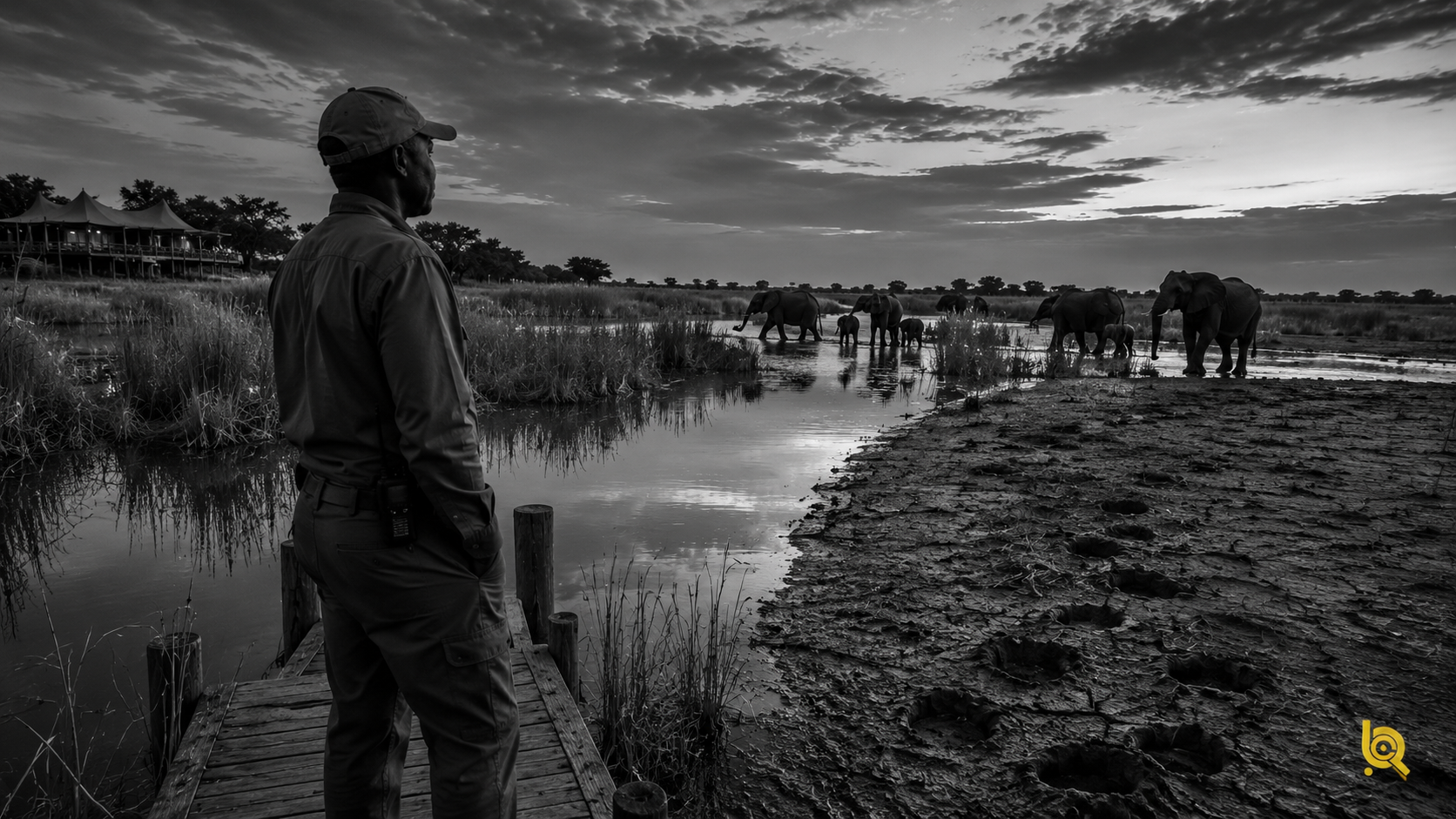
Every Botswana tourism pitch makes the same promise, implicitly or explicitly: come and see something ancient, unspoiled, and unchanged by the forces that have degraded almost every other wild place on earth. The Okavango Delta, the pitch goes, is a UNESCO World Heritage Site, an inland delta unlike any other on the planet, a place where the flood arrives in the dry season, where elephants move silently through papyrus, where the only sounds at dawn are water and birds and the occasional grunt of a hippo. It is real. It is extraordinary. And it has been, for decades, both the foundation of Botswana’s tourism economy and a genuine conservation achievement that the country is right to be proud of.
But “unspoiled” and “unchanged” are not descriptions of a fixed state. They are descriptions of a condition that requires active management to maintain, in a climate system that is not cooperating, with human and wildlife populations that are not static, and against infrastructure pressures that grow with every year the tourism dollar becomes more important to the national economy. The question that Botswana’s tourism planners need to sit with — and that the country’s economic planners need to sit with alongside them — is what happens to the brand when the wilderness itself is in transition.
2026: An Exceptional Flood Year
In early 2026, the Okavango Delta is in the middle of what operators, guides, and conservation researchers are describing as one of the most expansive flood years in recent memory. Strong rainfall across the Angolan Highlands, combined with locally heavy rains and already saturated conditions following 2025’s generous wet season, has produced a flood pulse that opened channels that had lain dry for years, reconnected floodplains that had separated, and pushed water into corners of the system that infrequent visitors had begun to assume were simply not part of the Delta anymore.
This is, on its face, excellent news for the 2026 safari season. Wildlife is concentrating around newly charged waterways. Predator dynamics are shifting as prey disperses across newly accessible grazing. Guides from Wilderness Destinations and other operators describe a system “running better for longer,” with cascading effects up the food chain. International bookings are strong. The brand is, at this particular moment, performing exactly as promised.
The instinct to take this as reassurance would be a mistake. What the 2026 flood season actually demonstrates is the Delta’s radical dependence on conditions that originate more than 1,600 kilometres away, in the Angolan Highlands, over which Botswana has no influence whatsoever. The Okavango River travels that distance before reaching Botswana, arriving months after the rains. The Delta’s annual flood pulse is determined by Angolan precipitation patterns, Namibian channel conditions along the Caprivi Strip, and the dynamics of the Kalahari Basin into which the system spreads. When those upstream conditions are generous, as they are in 2026, the Delta thrives. When they are not — as was increasingly the concern during several consecutive low-water years in the mid-2010s and early 2020s — the Delta contracts, channels close, wildlife disperses, and the expensive lodge experience becomes harder to justify at $2,500 a night.
The Elephant Problem
If climate variability is the external pressure on the Okavango ecosystem, the elephant is the internal one. Botswana is home to roughly 130,000 elephants — approximately a third of the world’s remaining savannah elephant population — and the Okavango-Chobe corridor hosts some of the highest elephant densities anywhere. The IUCN’s World Heritage Outlook for the Okavango Delta specifically associates biodiversity loss in the area with the “increasingly high elephant population,” citing habitat modification from overgrazing, tree damage, and the alteration of vegetation communities that have implications for other species that depend on those habitats.
Botswana banned trophy hunting in 2014 and partially reinstated it in 2019 specifically in response to community pressure around human-wildlife conflict and the fiscal argument that regulated hunting generated revenue for conservation management and community trusts. The debate around hunting is a genuine one, and neither the ban nor the reinstatement fully resolved the underlying population management question. What is not in serious dispute is that an elephant population at this density, without some form of active management, is shaping the Okavango ecosystem in ways that will alter the safari experience over time — fewer trees in some areas, changes to the large-cat habitat that depends on the vegetation structure those trees support, pressure on water and grazing resources at the interface between wildlife management areas and communal farming land.
Botswana’s tourism brand rests on the premise that its wilderness is exceptional. What it has not fully reckoned with is that exceptional wilderness requires exceptional management — and that management has costs the $2,500-a-night price has not yet fully funded.
The Infrastructure Pressure
There is a third pressure that receives less analytical attention than climate variability or elephant management: the relationship between tourism’s expanding role in the economy and the conservation model that makes the tourism premium possible. As diamonds decline and the government increasingly looks to tourism to compensate, the institutional pressure to increase visitor numbers — to double arrivals within five years, as the Botswana Tourism Organisation’s stated goal describes — sits in direct tension with the low-volume model that protects the asset generating the premium in the first place.
The new CBNRM Act, signed in January 2026, attempts to address the community benefit dimension of this pressure. andBeyond’s new Under Canvas circuit, offering more accessible price points within the Delta ecosystem, extends the premium experience to a slightly wider market. The AviaDev Africa route development forum hosted in Botswana in June 2026 is aimed at improving air access and increasing arrival volumes. None of these individually breaks the conservation model. But the cumulative pressure of expanding tourism infrastructure into areas that have, until now, been managed for minimal impact is a direction that, over time, moves toward the Mara and away from the Okavango — toward a market defined by volume rather than exclusivity.
The Premium Depends on the Wilderness. The Wilderness Depends on the Plan
The Okavango Delta is not at risk of imminent collapse. It is one of the most resilient and carefully managed ecosystems in the world, and the record 2026 flood season is a reminder of what it can be when the conditions align. But “resilient” and “invulnerable” are not the same thing, and a national brand built on the premise of an unchanging wilderness is carrying the kind of long-term risk that needs to be named and planned for, not deferred until it becomes visible. The climate is changing. The elephant population is at historically high densities. The economic pressure to expand the tourism footprint is growing. Botswana’s response to each of these challenges, and whether those responses are coordinated enough to protect the whole rather than just manage each pressure individually, is the governance question that will determine whether the Okavango brand remains the premium asset the country needs it to be, or whether it gradually becomes something more ordinary — still worth visiting, but no longer justifying the price that funds the conservation that makes it extraordinary.
Sources: Africa Geographic; The Traveler; Wilderness Destinations; Okavango Delta.com; IUCN World Heritage Outlook (Okavango Delta); Worldcrunch; Botswana Tourism Organisation; Ngami Times; Travel and Tour World.